
Hydraulic fittings: types, function and how to choose them
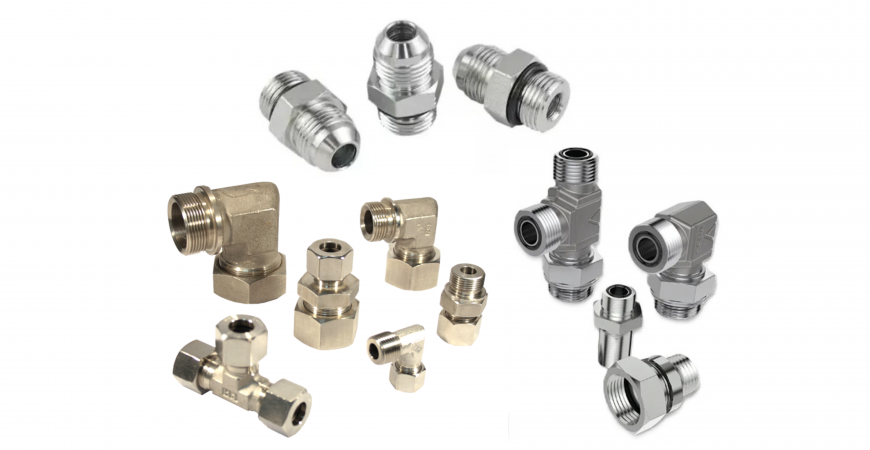
Pumps, valves, cylinders, pipes, and hoses need fittings capable of securely joining each component, ensuring fluid circulation and maintaining circuit tightness.
In this context, hydraulic fittings are essential components. Although they may seem like simple elements within an installation, their correct selection has a direct influence on the safety, reliability, watertightness, and service life of the hydraulic system .
What is a hydraulic fitting?
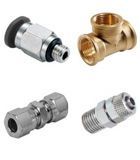
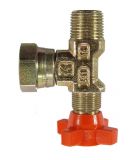
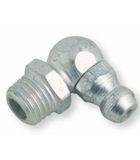
A hydraulic fitting is a mechanical component used to connect different elements of a hydraulic circuit , such as rigid pipes, hoses, valves, pumps, hydraulic cylinders, or control blocks.
The main function is to ensure that the joint is mechanically strong and watertight , even when the circuit is subjected to pressure, vibrations, temperature variations, or movement.
Depending on the design, a fitting can be used for:
- Join two tubes or hoses.
- Connect a pipe to a valve or cylinder.
- To change the direction of a drive.
- Adapt different diameters or thread types.
- To make branches within a circuit.
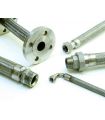
- Connect a hydraulic hose to a piece of equipment.
How does a hydraulic fitting work?
The operating principle depends on the connection system used. In some fittings, sealing is achieved through contact between machined metal surfaces. In others, additional elements such as cutting rings, O-rings, cones, washers, or specific sealing elements are involved.
Main types of hydraulic fittings
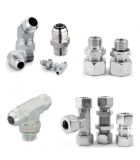
DIN 2353 fittings, also associated with the ISO 8434 standard, constitute one of the most widespread systems for connecting pipes in hydraulic installations.
They are based on a joining system using a cutting ring and allow rigid tubes to be connected to different circuit components.
Within this family, we find the light series and the heavy series. Your choice will depend on the pipe diameter and the installation pressure conditions.
Tapered sealing fittings, such as certain 60° configurations, use tapered surfaces to achieve contact and sealing between components.
This type of fitting can be found in various hydraulic and pneumatic applications and in different thread and material configurations.
Stainless steel hydraulic fittings
When the installation is exposed to aggressive environments or there is a high demand against corrosion, stainless steel fittings are a suitable alternative.
How to choose a hydraulic fitting?
Selecting the right fitting requires analyzing several technical parameters.
- Working pressure
This is a determining factor, as the fitting must withstand the maximum working pressure expected for the circuit. Furthermore, potential pressure spikes, pulsations, and water hammer must be taken into account.
- Connection type
The system used must be taken into account: BSP thread, NPT thread, metric threads, DIN 2353 connections, JIC connections, ORFS connections or flanged connections.
Diameter
The diameter of the tube or hose must be compatible with the selected fitting.
- Material
The material must be selected taking into account the environment and the fluid. Among the materials used in hydraulic fittings, steel and stainless steel are the most prominent.
Operating temperature
The temperature of the fluid and the environment can affect both the fitting material and the sealing elements.
- Fluid type
Not all materials or seals are compatible with all fluids. This is especially important in applications using specific oils, chemicals, or fluids other than conventional hydraulic oils.
In short, there is no single fitting suitable for all applications; rather, it is necessary to select the fitting taking into account the entire hydraulic system and its operating conditions.
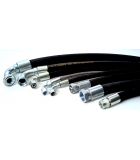
At Disumtec we have a wide range of hydraulic connection solutions, including DIN 2353 fittings, stainless steel versions and different configurations for hydraulic installations , as well as the manufacture of custom hydraulic hoses .

 English GB
 Español
 Português PT
 Français
 Deutsch
 Italiano