Hydraulic accumulators. Buy online at the best price.
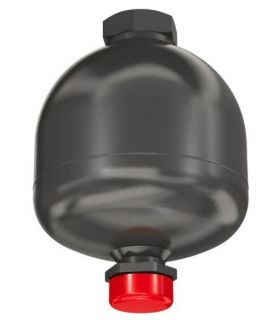
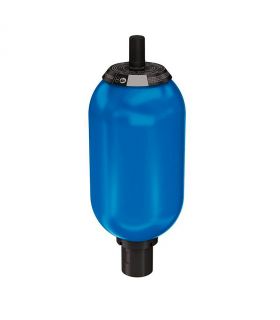
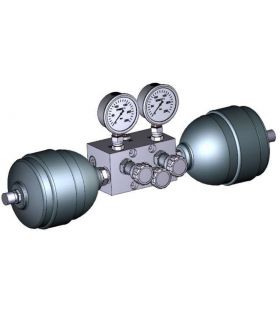
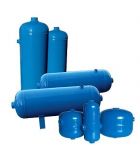
A hydraulic accumulator is a reservoir for storing oleohydraulic fluid, i.e., substances primarily derived from petroleum, such as mineral oil. This type of equipment is characterized by being pressurized by an external energy source, usually hydraulic oil.
Inside, a membrane or bladder is installed that is charged with gas, usually Nitrogen, at a certain pressure. This is then responsible for providing the oil reserve that accumulates inside, to provide that pressure to the installed equipment.
Operation of hydraulic accumulators
The operation is simple: when the circuit pressure exceeds the nitrogen pressure, the oil begins to enter the accumulator, compressing the gas.
If the circuit pressure is lower than that of the compressed gas in the accumulator, the accumulated oil volume in the container is returned to the reservoir thanks to the expansion of the nitrogen, which will be stronger than the oil side of the system. Both fluids will be separated by a membrane or bladder, as described above.
Applications of hydraulic accumulators
- Energy reserve application: When we need to exert effort once the pump has stopped, or to perform a movement faster than the installed pump's flow rate allows, we turn to an accumulator, where we store the oil we need and release it when necessary. In cases of power loss, a cylinder or motor may be in a "stressed" position. In these cases, with the pressurized oil reserved in our accumulator, we can help it return to a resting or end-of-function position (lowering a platform, opening a gate, etc.).
- Impulse and noise dampening: When, for technical reasons, due to the type of application, vibrations occur in the system, we install an accumulator, which acts as a "silencer" of the noise in the pipes. Larger-volume piston pumps incorporate a small accumulator that softens the impact between piston pulses.
- Thermal expansion: Liquids tend to increase in volume when heated. In pressurized circuits, this is solved by using an accumulator in the system, which absorbs the increased oil volume. Many hot water boilers have an expansion tank to avoid having to pump and refill water every time the circuit is heated.
- Anti-water hammer: Some hydraulic systems experience sudden interruptions or shutdowns, which can generate water hammer in the line. The accumulator absorbs these shocks, protecting the system components. Solenoid valves are a clear example of these shocks caused by a change in direction caused by movement. If operating at high pressures or rapid (abrupt) changes, the accumulator will absorb these changes, relieving the system.
- Suspension applications: The accumulator is an elastic element with the great advantage that the force exerted (gas-oil system) can be easily adapted at any time, withstanding repetitive pressure shocks. Vehicle wheel suspensions and driver seats use them to absorb the bumps caused by movement.
- Power Restoration/Pressure Maintenance: Accumulators maintain flow for a specified period of time and protect machinery and expensive installations in the event of power outages or system failures. They can also be used to save energy by shutting down system pumps during pressure maintenance operations.