Pressure Gauge or Vacuum Gauge? Similarities and Differences

Pressure Gauge VS Vacuum Gauge
Confusion often arises between these two instruments that appear similar but perform complementary functions: the pressure gauge and the vacuum gauge.
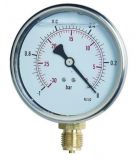
Both are pressure measuring instruments; the difference is that the manometer measures pressures above atmospheric pressure, and the vacuum gauge measures pressures below atmospheric pressure.
Vacuum gauge
A vacuum gauge is a measuring instrument that measures the vacuum pressure in a system.
It is used to measure pressure when it is lower than atmospheric pressure. In other words, a vacuum gauge is capable of measuring a vacuum.
The purpose of a vacuum gauge is to measure how much pressure drops in a given environment. Using a vacuum gauge, the operation of a two- or multi-cylinder engine, whose function is to draw in and compress gases, can be monitored and analyzed. One of the uses of this tool is the synchronization of carburetors or fuel injection systems, that is, adjusting all cylinders equally.
Another function of a vacuum gauge is detecting engine faults without disassembly. A lack of pressure in a cylinder indicates a problem, and the vacuum gauge helps identify it early.
What are the typical applications of vacuum gauges?
- Industrial use: To control pressure in industrial processes such as vacuum drying or distillation.
- Pick and place: Vacuum pick and place applications are found in many industries, including automotive, food and beverage, manufacturing, pharmaceutical, chemical, and marine.
- Medical equipment: In suction devices and vacuum-assisted delivery systems.
- HVAC Systems: When installing or repairing a refrigerant circuit, a vacuum is created to evacuate air and matter from the system.
- Research: To measure and control pressure in laboratory experiments. For example, pressure can be measured in a vacuum to see how materials behave at low pressures.
- Automotive: To monitor vacuum in brake systems with power brakes, which controls proper braking.
- Food processing: To monitor pressure levels in vacuum packaging machines.
- Pharmaceutical: To monitor pressure levels in vacuum drying and granulation processes.
- Water pump systems for fire services: Fire services use systems to pump water, typically equipped with special vacuum gauges called compound gauges. Compound gauges can measure both positive and negative pressure.
Pressure gauge
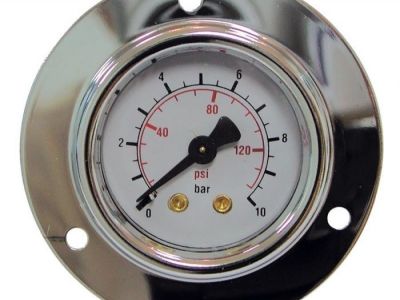
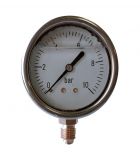
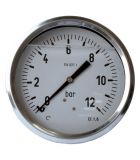
The pressure gauge is an essential instrument for measuring the pressure of gases or liquids in various industrial environments. Its classic design is analog, characterized by a graduated dial and a mechanically driven needle that accurately indicates both increases and decreases in the pressure level of fluids such as water, air, or oil.
Currently, they coexist with digital pressure gauges, which display pressure readings on a backlit screen. These advanced models often integrate valuable additional features, such as customizable alarms or wireless data transmission, facilitating more sophisticated monitoring.
This equipment is not just a measuring tool, but an indispensable safety device. It allows organizations to quickly identify any pressure anomalies in the production plant, enabling early intervention to prevent risks.
Among its many applications, a pressure gauge is key to determining:
- The flow rate of a liquid circulating in a tank or container.
- The efficiency of a filter, by showing its pressure drop.
- The existence of internal leaks in pipes or tanks.
- The volume or level of a liquid within a storage tank.
They are used in compressed air systems, pressurized water lines, hydraulic circuits, boilers, vehicle tires, etc.