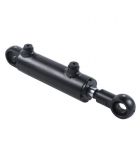
What is a clamp cylinder fixing?
The clamping cylinder fixing is the set of elements and mechanical solutions that allow a clamping cylinder to be installed, secured and stabilized within a structure or machine, ensuring that its force is transmitted efficiently and in a controlled manner.
The clamping of clamping cylinders is a key element in industrial systems where parts need to be immobilized, positioned, or clamped reliably and repeatedly. Proper clamping not only ensures system performance but also improves safety and extends the service life of the components.
What are the most common types of mounting?
Depending on the application and available space, there are three main configurations:
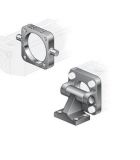
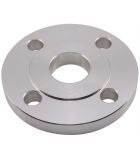
- Flange Mounting: Ideal for direct axial forces; it screws in from the front or side.
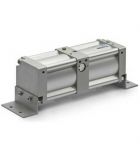
- Foot Mounting: The cylinder rests on L-shaped supports, ideal for when longitudinal space is limited.
- Oscillating Mounting: Allows the cylinder to tilt slightly, compensating for misalignments in machines with curved or irregular movements.
Can I adapt a standard fixing to a special cylinder?
Most industrial cylinders comply with standards such as ISO 15552 or ISO 6432, allowing for interchangeable mountings. However, for high-pressure cylinders or special sizes, it is essential to manufacture custom-made supports that respect the center of gravity of the load to prevent structural failure.
Why is good fixation important?
Improper fastening can cause:
- Loss of precision in pressing
- Misalignment and premature wear
- Vibrations and system failures
- Operational risks
Why should you choose the right fastener?
Improper mounting is the number one cause of premature actuator failure. If the cylinder is not perfectly aligned:
- Uneven wear occurs in the sealing gaskets.
- The stem may suffer lateral deformations (buckling).
- It increases air or energy consumption due to unnecessary internal friction.